Pages

Showing posts with label Cross Island. Show all posts

Thursday, August 6, 2020

"MESSAGE CARVED BY JFK LEADS TO RESCUE OF PT109 CREW"

WITHOUT THE COCONUT, THE REST WOULD NOT HAVE BEEN POSSIBLE

Cross Island (JFK+50) On August 6, 1943, Lt. John F. Kennedy along with two friendly natives, Biuku Gasa and Eroni Kumana, canoed to Cross Island to pick up Ensign Barney Ross.  JFK found a coconut and with his knife, carved a message on it and asked the natives to take it to the coast watcher on Wana Wana.

The message reads...

"Nauro Isl - Commander - Native Knows Posit - He Can Pilot - 11 Alive - Need Small Boat - Kennedy"

The natives canoed to Rendova Harbor 38 miles away with the coconut message...soon help would be on the way to rescue the survivors of PT109.

After the rescue, JFK managed to retrieve the coconut and later had it encased in wood and plastic. According to the JFK Library, "history does not record" how JFK got the coconut back.   It was displayed on his desk in the Oval Office at the White House and today it is on display at the John F. Kennedy Presidential Library in Boston.  

Dave Powers, JFK's Presidential assistant and later curator, said that it was the most important object in the library because without it all the rest would have never been possible.

SOURCES

"Coconut shell paperweight with PT109 rescue message," John F. Kennedy Presidential Library and Museum, www.jfklibrary.org/

"11 ALIVE...NEED SMALL BOAT...KENNEDY," Letters of Note, April 20, 2011, www.lettersofnote.com/

"PT 109, John F. Kennedy in WWII," by Robert J. Donovan, McGraw-Hill Publishers, New York, 1961, 2001.

"Why JFK kept a Coconut Shell in the Oval Office," by Kat Eschner, Smithsonian Magazine, August 2, 2017, www.smithsonianmag.com/


JFK's Coconut Message Paperweight
JFK Library Photo


Tuesday, August 4, 2020

"THE PALMS OF HIS HANDS WERE SWOLLEN TO A THICKNESS OF 3 INCHES"

'OFF THE ISLE OF OLASANA, IN THE STRAIT BEYOND NARU'
  
Olasana, South Pacific (JFK+50) On August 4, 1943, after having made the long swim from the wreckage of PT109 to Plum Pudding Island,  Lt. j.g. John F. Kennedy and his surviving crewmen swam to Olasana Island.  

Short on food and coconut milk, JFK ordered his crew to swim to the island closer to Ferguson Passage in hopes of being rescued.  Olasana is located 1 & 3/4 miles SW of Plum Pudding.  They began their swim at noon with JFK again towing the badly burned "Pappy" McMahon.

Robert J. Donovan describes the severity of McMahon's condition...

"It broke Kennedy's heart to look at him.  Scabs forming over his burned eyelids made it difficult for him to see.  The palms of his hands were swollen to a thickness of three inches.  They were cracked...and he could look deeply into his own flesh." 

The weary swimmers arrived at an islet west of Cross Island at 3 in the afternoon.  According on Donovan...

"The eleven survivors gathered in the trees behind the curved beach on the southeastern tip of Olasana, whence they could look straight across another half-mile of water to Naru Island bordering Ferguson Passage."

The decision was made to stay in the spot and not risk exploring the island which was twice as large as Plum Pudding.  The water in Ferguson Passage was too cold that evening for anyone to attempt to swim out to seek help.  

SOURCE

"PT109, John F. Kennedy in World War II," by Robert J. Donovan, McGraw-Hill, New York, 1961, 2001.


Sunday, August 4, 2019

"OFF THE ISLE OF OLASANA, IN THE STRAIT BEYOND NARU"

PT 109 CREW SWIMS CLOSER TO RESCUE

Olasana, South Pacific (JFK+50) On August 4, 1943, after having made the long swim from the wreckage of PT109 to Plum Pudding Island,  Lt. j.g. John F. Kennedy and his surviving crewmen swam to Olasana Island.  Short on food and coconut milk, JFK ordered his crew to swim to the island closer to Ferguson Passage in hopes of being rescued.

Olasana is located one and three quarters of a mile southwest of Plum Pudding.
They began their swim at noon with JFK again towing the badly burned "Pappy" McMahon.

Robert J. Donovan, in his book PT 109, John F. Kennedy in World War II describes the severity of McMahon's condition...

"It broke Kennedy's heart to look at him.  Scabs forming over his burned eyelids made it difficult for him to see.  The palms of his hands were swollen to a thickness of three inches.  They were cracked...and he could look deeply into his own flesh." 

The weary swimmers arrived at an islet west of Cross Island at 3 in the afternoon.  According on Donovan...

"The eleven survivors gathered in the trees behind the curved beach on the southeastern tip of Olasana, whence they could look straight across another half-mile of water to Naru Island bordering Ferguson Passage."

The decision was made to stay in the spot and not risk exploring the island which was twice as large as Plum Pudding.  The water in Ferguson Passage was too cold that evening for anyone to attempt to swim out to seek help.  

SOURCE

"PT109, John F. Kennedy in World War II," by Robert J. Donovan, McGraw-Hill, New York, 1961, 2001.


Monday, August 6, 2018

THE MOST IMPORTANT OBJECT IN THE JFK LIBRARY

MESSAGE ON COCONUT SAVES THE DAY

Cross Island (JFK+50) On August 6, 1943, Lt. John F. Kennedy along with two friendly natives, Biuku Gasa and Eroni Kumana, canoed to Cross Island to pick up Ensign Barney Ross.  JFK found a coconut and with his knife, carved a message on it and asked the natives to take it to the coast watcher on Wana Wana.

The message reads...

"Nauro Isl - Commander - Native Knows Posit - He Can Pilot - 11 Alive - Need Small Boat - Kennedy"

The natives canoed to Rendova Harbor 38 miles away with the coconut message...soon help would be on the way to rescue the survivors of PT109.

After the rescue, JFK managed to retrieve the coconut and later had it encased in wood and plastic. According to the JFK Library, "history does not record" how JFK got the coconut back.   It was displayed on his desk in the Oval Office at the White House and today it is on display at the John F. Kennedy Presidential Library in Boston.  

Dave Powers, JFK's Presidential assistant and later curator, said that it was the most important object in the library because without it all the rest would have never been possible.

SOURCES

"Coconut shell paperweight with PT109 rescue message," John F. Kennedy Presidential Library and Museum, www.jfklibrary.org/

"11 ALIVE...NEED SMALL BOAT...KENNEDY," Letters of Note, April 20, 2011, www.lettersofnote.com/

"PT 109, John F. Kennedy in WWII," by Robert J. Donovan, McGraw-Hill Publishers, New York, 1961, 2001.

"Why JFK kept a Coconut Shell in the Oval Office," by Kat Eschner, Smithsonian Magazine, August 2, 2017, www.smithsonianmag.com/


JFK's Coconut Message Paperweight
JFK Library Photo


Saturday, August 6, 2016

11 ALIVE NEED SMALL BOAT KENNEDY

JFK+50:  Volume 6, No. 2032

A COCONUT MESSAGE LEADS TO RESCUE OF JFK AND PT109 CREW

Cross Island, Solomon Islands (JFK+50) Seventy three years ago today, August 6, 1943, Lt. John F. Kennedy along with two friendly natives, Biuku Gasa and Eroni Kumana, canoed to Cross Island to pick up Ensign Barney Ross.

Lt. Kennedy picked up a coconut and with his knife carved a message.  JFK asked the natives to take it to the coastwatcher on Wana Wana.

The message reads...

"Nauro Isl - Commander - Native Knows Posit - He Can Pilot - 11 Alive - Need Small Boat - Kennedy"

The natives canoed to Rendova Harbor 38 miles away with the coconut message...soon help would be on the way to rescue the survivors of PT109.

After the rescue, JFK managed to retrieve the coconut and later had it encased in wood and plastic.  It was displayed on his desk in the Oval Office at the White House. Today it can be seen at the JFK Library.

Dave Powers, Presidential assistant and later curator, said that it was the most important object in the library because without it, all the rest would have never been possible.

SOURCES

"Coconut shell paperweight with PT109 rescue message," John F. Kennedy Presidential Library and Museum, www.jfklibrary.org/

"11 ALIVE...NEED SMALL BOAT...KENNEDY," Letters of Note, April 20, 2011, www.lettersofnote.com/

"PT 109, John F. Kennedy in WWII," by Robert J. Donovan, McGraw-Hill Publishers, New York, 1961, 2001.


Toy Replica of Coconut Shell Message
With "JFK" GI Joe Toy
Photo by John White (2013)


JFK's Coconut Message Paperweight
JFK Library Photo


Sunday, August 4, 2013

JFK AND CREW SWIM TO OLASANA

August 4, 2013

JFK AND CREW SWAM TO OLASANA 70 YEARS AGO 

Olasana, South Pacific (JFK+50) After having made the long swim from the wreckage of the PT109 to Plum Pudding Island,  Lt. j.g. John F. Kennedy and his surviving crew swam to Olasana Island 70 years ago, August 4, 1943.

Short on food and coconut milk, Lt. Kennedy ordered his crew to swim to the island closer to Ferguson Passage in hopes of being rescued.

Olasana is located one and three quarters of a mile southwest of Plum Pudding.

They began their swim at noon with JFK again towing the badly burned "Pappy" McMahon.

Robert J. Donovan describes the severity of McMahon's condition...

"It broke Kennedy's heart to look at him.  Scabs forming over his burned eyelids made it difficult for him to see.  The palms of his hands were swollen to a thickness of three inches.  They were cracked...and he could look deeply into his own flesh." 

The weary swimmers arrived at an islet west of Cross Island at 3 in the afternoon. 

 According on Donovan...

"The eleven survivors gathered in the trees behind the curved beach on the southeastern tip of Olasana, whence they could look straight across another half-mile of water to Naru Island bordering Ferguson Passage."

The decision was made to stay in the spot and not risk exploring the island which was twice as large as Plum Pudding.

The water in Ferguson Passage was too cold that evening for anyone to attempt to swim out to seek help.  


SOURCE

"PT109, John F. Kennedy in World War II," by Robert J. Donovan, McGraw-Hill, New York, 1961, 2001.


               Adult PT109 Tee Shirt
  For Sale at the Kennedy Library
                      $19.95 (2011)


IKE WARNED OF BAD SITUATION IN ASIA

Seattle, Washington (JFK+50) President Dwight D. Eisenhower, speaking before the Governors Conference meeting here in Seattle 60 years ago today, warned that the situation in Asia was "ominous for the United States".

The President also said that the defense of French Indochina was a necessity to prevent a communist takeover.

Mr. Eisenhower's speech marked the origin of the Domino Theory which held that if one nation in Southeast Asia fell to the communists, all the other nations of the region would fall as well, like a set of dominoes.


FRANK FAMILY ARRESTED IN HOLLAND

Amsterdam, Holland (JFK+50) The family of Otto Frank*, including his daughters Anne** and Margot, who had been in hiding here in Amsterdam, was arrested 69 years ago today by the Gestapo.

The Franks were to be transported within the next several weeks to Auschwitz in Poland.

Anne Frank had received a notebook for her 13th birthday in 1942 in which she began writing her diary.  She wrote of her dream to become an actress and later a journalist.  

In her 1st entry, Anne wrote...

"I hope I will be able to confide everything to you...and I hope you will be a great source of comfort and support."

Although protected from the Nazis in her hiding place, the discomfort of confinement was difficult.

Anne wrote on October 29, 1943...

"Outside, you don't hear a single bird, and a deathly, oppressive silence hangs over the house...I wander from room to room...and feel like a songbird whose wings have been ripped off and who keeps hurling itself against the bars of its dark cage."

While Anne began writing in the notebook she was given on her birthday, she filled that one up and used other notebooks until her last entry of August 1st, 1944.

Anne's diary was published in the Netherlands under the title "Het Ashterhuis" or "The Secret" in 1947.  It was later published in the UK and USA in 1952 as "Anne Frank:  The Diary of a Young Girl."


SOURCE

About.com, Education, 20th Century History, by Jennifer Rosenberg, www.history190ss.about.com/


                   Anne Frank Statue
                          Amsterdam
             Photo by Hide-sp (2008)


*Otto Frank (1889-1980) was born in Frankfurt and served as an officer in WWI.  He worked in the family banking business until the early 1930s, then moved his family to Holland and started a spice company.

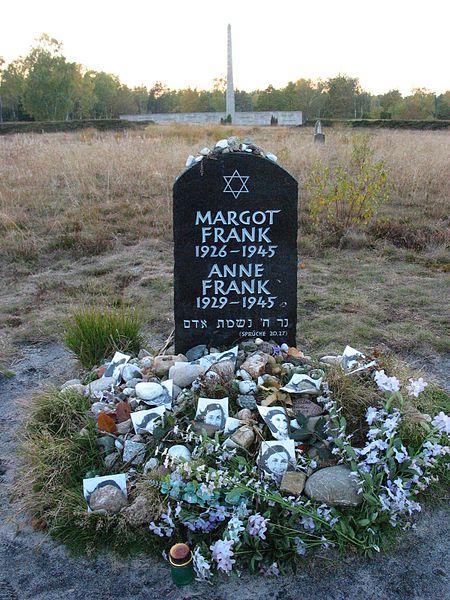
**Anne Frank (1929-2945) was born in Frankfurt.  She died just a few weeks before the Bergen-Belsen concentration camp was liberated by the British.


Memorial to Anne and Margot Frank
         Bergen-Belsen, Germany
        Photo by Arne List (2003)


JESSE OWENS WINS OLYMPIC LONG JUMP

Berlin, Germany (JFK+50) African-American athlete Jessie Owens won a gold medal here in Berlin at the Summer Olympic Games 77 years ago today, August 4, 1936.

Owens, who was a graduate of Ohio State University, won the long jump.

His jump of 26 feet, 5 and one-half inches set an Olympic record.

Known as "the Buckeye Bullet", Jesse Owens set a record that was to stand for 24 years.  

At Ohio State, he won 8 individual NCAA championships.

Owens was born in Oakville, Alabama in 1913.  He died at the age of 66 in Tuscon, Arizona in 1980.

Jesse Owens is quoted as saying...

"I let my feet spend as little time on the ground as possible.  From the air, fast down, and from the ground, fast up."


       Jesse Owens Wins Gold Medal
                    August 4, 1936
     German National Archive Photo