Pages

Showing posts with label Edmund Pettus Bridge. Show all posts

Thursday, March 7, 2019

"IN SELMA, IT SEEMS LIKE EVERYTHING & NOTHING HAS CHANGED"

VIOLENCE IN SELMA LEADS TO VOTING RIGHTS ACT

Selma, Alabama (JFK+50) On March 7, 1965, 600 marchers demonstrating for voting rights were brutally attacked with clubs and tear gas by state and local police here in Selma.  After crossing Edmund Pettus* Bridge, the group, led by John Lewis of SNCC and Rev. Hosea Williams of SCLC were confronted by authorities.

17 marchers were injured and  hospitalized.  Leaders of the march said that despite the attacks, more marches would follow.  Of the 15,000 blacks in Dallas County** only 130 were registered to vote.  Bloody Sunday was a key event leading to passage of the Voting Rights Act of 1965.

On February 11, 2015, the House of Representatives passed a resolution awarding the Congressional Gold Medal "to the foot soldiers of the 1965 voting rights movement in Selma."  Ari Berman writes that in Selma, civil rights history is everywhere.  Its streets are named after civil rights activists.


*Edmund Pettus was a general in the Confederate army & leader of the Alabama Ku Klux Klan.

**In 2014, Dallas County (80% African-American) was the poorest county in the state of Alabama.  More than 40% of its residents lived below the poverty line.  Ari Berman writes...."In Selma, it feels like everything and nothing has changed."

SOURCE

"Fifty Years After Bloody Sunday in Selma, Everything and Nothing Has Changed," by Ari Berman, The Nation, February 25, 2015, www.thenation.com/

"Five things to know about Bloody Sunday this weekend," by the editors of USA Today, March 7, 2015,  www.usatoday.com/


Bloody Sunday
Selma, Alabama (1965)
By Kevin Saff
at en.wikipedia

Saturday, March 7, 2015

50TH ANNIVERSARY IN SELMA

A BLOODY SUNDAY IN SELMA 50 YEARS AGO  

Selma, Alabama (JFK+50) Fifty years ago today, March 7, 1965, 600 marchers demonstrating for voting rights were brutally attacked with clubs and tear gas by state and local police here in Selma.

After crossing Edmund Pettus Bridge, the group, led by John Lewis of SNCC (Southern Non-Violent Coordinating Committee) and Rev. Hosea Williams of the Southern Christian Leadership Conference, were confronted by authorities.

17 marchers were injured and  hospitalized. Leaders of the march said that despite the attacks, more marches would follow.  Of the 15,000 blacks in Dallas County in 1961 only 130 were registered to vote. 

"Bloody Sunday" was one of the key events leading to passage of the Voting Rights Act of 1965.

President Barack Obama is scheduled to deliver a commemoration speech today at 12 o'clock and tomorrow Congressman Lewis and Rev. Williams will lead the commemoration march.  More than 100,000 people are expected to attend.

Today in Montgomery, Alabama, Patti LaBelle will give a concert titled "The Dream Marches On." 

SOURCE

"5 things to know about Bloody Sunday this weekend," by the editors of USA Today, March 7, 2015,  www.usatoday.com/


Bloody Sunday
Selma, Alabama (1965)
By Kevin Saff
at en.wikipedia


National Historic Marker
Selma to Montgomery
By Markuskun (2007)


Friday, March 7, 2014

SEVENTH OF MARCH

BLOODY SUNDAY IN SELMA 49 YEARS AGO 

Selma, Alabama (JFK+50) 49 years ago today, March 7, 1965, 600 marchers demonstrating for African-American voting rights were brutally attacked with clubs and tear gas by state and local police here in Selma.

After crossing the Edmund Pettus Bridge, the group led by John Lewis of the Student Non-Violent Coordinating Committee and Rev. Hosea Williams of the Southern Christian Leadership Conference were confronted by authorities.


Civil Rights Demonstration
Edmund Pettus Bridge
Selma, Alabama

Seventeen marchers were injured and  hospitalized. 

The leaders of the march said that despite the attacks, more marches will follow.

Of the 15,000 blacks in Dallas County in 1961 only 130 were registered to vote. 

"Bloody Sunday" would prove to be one of the key events leading to passage of the Voting Rights Act of 1965.


National Historic Marker
Selma to Montgomery


JFK PLANS DINNER FOR NEWS WRITERS

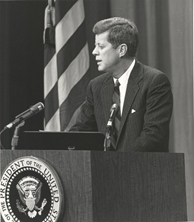
Washington, D.C. (JFK+50) At his 26th news conference held 52 years ago today, March 7, 1962, President John F. Kennedy was asked the following question:

"Mr. President: 

 You have said....that heads of government should not go to the summit to negotiate agreements but only to approve agreements negotiated at a lower level. 

Now it is being...written that you are going to eat those words and go to a summit without any agreement at a lower level.

Has your position changed, sir?"

The President responded:

"Well, I'm going to have a dinner for all the people who have written it and we will see who eats what."

JFK's answer was followed with laughter from the reporters attending the conference held in the State Department Auditorium.


JFK at Press Conference

ROBERT FROST PUBLISHES POEM

The New Republic published a poem 91 years ago today, March 7, 1923, written by Robert Frost

The title of the poem is: 

"Stopping By the Woods on a Snowy Evening".

"Whose woods these are I think I know. 
His house is in the village though; 
He will not see me stopping here 
To watch his woods fill up with snow.  

My little horse must think it queer 
To stop without a farmhouse near 
Between the woods and frozen lake 
The darkest evening of the year.  

He gives his harness bells a shake 
To ask if there is some mistake. 
The only other sound's the sweep
Of the easy wind and downy flake. 

The woods are lovely, dark, and deep,
But I have promises to keep, 
And miles to go before I sleep, 
And miles to go before I sleep. "


Born in California, Mr. Frost moved to New England when he was 11 years old.  Although he attended both Dartmouth and Harvard, Frost did not complete requirements for a degree.

In 1912, Frost moved to England to work on his poetry.  After World War I broke out, he bought a farm in New Hampshire.

JFK, a lover of poetry and admirer of Robert Frost, invited him to his inauguration.  

Mr. Frost penned a new poem for the occasion but when he tried to read it, the bright sunlight made it difficult so he recited from memory another poem.


Robert Frost 
January 20, 1961

The original poem, in Frost's own handwriting, showed up in the mail at the JFK Library in 2006.  

With the poem was a note from Jackie Kennedy which said "this is the 1st thing I had framed to put in (the oval) office."


JFK Library, Boston