Pages

Showing posts with label PT 109. Show all posts

Sunday, August 2, 2020

"JFK TOWED A BADLY BURNED SAILOR TO PLUM PUDDING ISLAND"

JFK'S PT109 RAMMED & SUNK IN SOUTH PACIFIC

Rendova, Tulagi (JFK+50) On August 2, 1943, Lt. j.g. John F. Kennedy and his crew were on patrol on board PT109* in the Solomon Islands of the South Pacific when they were rammed and sunk by the Japanese destroyer Amagiri.** 

The destroyer plowed through the torpedo-patrol boat at 2:30 a.m. moving at a high rate of speed leaving 109 split in half and in flames as spilled fuel ignited.  JFK, although injuring his back in the collision, was able to account for 11 of his 13 man crew and get them safely on the hull of his boat which stayed afloat.   

The missing sailors were Andrew Kirksey and Harold Marney.  In addition to JFK, the surviving crew included...Leonard J. Thom, Raymond Albert, Charles A. Harris, William Johnston, George Ross, Edgar Mauer, John McGuire, Patrick H. McMahon, Raymond Starkey, and Gerald Zinser. 

The most badly injured crewman, Patrick H."Pappy" McMahon, had been at his post below deck in the engine room at the time of the collision.  

By dawn, JFK decided to abandon his sinking hull and  ordered his men to make a swim to nearby Plum Pudding Island.  The sailors placed a lantern and their shoes on top of pieces of timber that had been used to secure a 37mm gun.  
Clenching the strap of a life preserver put around McMahon's waist, JFK towed the badly burned sailor while doing the breast stroke.  At 6:30 p.m., after making it to Plum Pudding, Lt. Kennedy swam back out alone into Ferguson Passage in a vain attempt to flag down a passing friendly ship.

SOURCE

"PT 109: John F. Kennedy in World War II," by Robert J. Donovan, McGraw-Hill, New York, 1961

*PT109 was launched on June 20, 1942.  It was 80 feet long and had 4 torpedo tubes, a 20mm cannon, 4 machine guns and a 37 mm anti-tank gun.
The 109 was made of wood and ran on highly flammable aviation fuel.

**Amagiri was a Fubuki-class destroyer launched in 1930 and built at the Tokyo Ishikawajima Shipyards.  It was a new type of destroyer noted for its large size, powerful engines and high speeds.


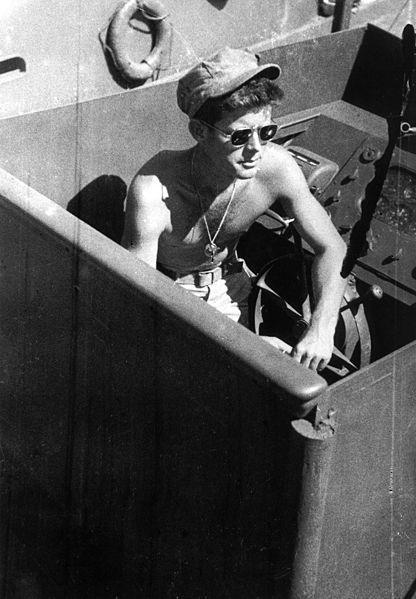
JFK at the Helm of  PT109
JFK Library Photo


US Flag Flown on the PT 109
 JFK Library Photo

Tuesday, August 4, 2015

ORIGIN OF DOMINO THEORY

IKE CALLS SITUATION IN ASIA "OMINOUS" FOR THE UNITED STATES

Seattle, Washington (JFK+50) President Dwight D. Eisenhower, speaking before the Governors Conference meeting here in Seattle sixty-two years ago today, August 4, 1953,warned that the situation in Asia was "ominous for the United States".

The President also said that the defense of French Indochina was a necessity to prevent a communist takeover.

Mr. Eisenhower's speech marked the origin of the Domino Theory which held that if one nation in Southeast Asia fell to the communists, all the other nations of the region would fall as well, like a set of dominoes.


PT 109 CREW SWIMS TO OLASANA 

Olasana, South Pacific (JFK+50) After having made the long swim from the wreckage of PT109 to Plum Pudding Island,  Lt. j.g. John F. Kennedy and his surviving crewmen swam to Olasana Island 72 years ago today, August 4, 1943.

Short on food and coconut milk, Lt. Kennedy ordered his crew to swim to the island closer to Ferguson Passage in hopes of being rescued.

Olasana is located one and three quarters of a mile southwest of Plum Pudding.


PT-109 Collision
Solomon Islands 1943 EN Philg88
Wikipedia Foundation
www.wikimedia.org


They began their swim at noon with JFK again towing the badly burned "Pappy" McMahon.   Robert J. Donovanin his book PT 109, John F. Kennedy in World War II describes the severity of McMahon's condition...

"It broke Kennedy's heart to look at him.  Scabs forming over his burned eyelids made it difficult for him to see.  The palms of his hands were swollen to a thickness of three inches.  They were cracked...and he could look deeply into his own flesh." 

The weary swimmers arrived at an islet west of Cross Island at 3 in the afternoon.  According on Donovan...

"The eleven survivors gathered in the trees behind the curved beach on the southeastern tip of Olasana, whence they could look straight across another half-mile of water to Naru Island bordering Ferguson Passage."

The decision was made to stay in the spot and not risk exploring the island which was twice as large as Plum Pudding.

The water in Ferguson Passage was too cold that evening for anyone to attempt to swim out to seek help.  

SOURCE

"PT109, John F. Kennedy in World War II," by Robert J. Donovan, McGraw-Hill, New York, 1961, 2001.


Sunday, September 28, 2014

JFK LETTERS SOLD AT AUCTION

JFK'S LETTERS TO FAMILY OF NAVY CREWMAN SOLD AT AUCTION

Boston, Massachusetts (JFK+50) According to wire service reports published last week, letters written by Lt. John F. Kennedy to the family of PT crewman Harold Marney during World War II have sold at auction.

Marney was one of the two crewman of the PT109 who were killed in the collision with the Japanese destroyer Amagiri in August 1943.

The collection of letters was sold by Boston-based RR Auction Company at the Omni Parker House.  Along with these letters, another set written by Robert F. Kennedy to a classmate at the Portsmouth Abbey School in Rhode Island was also sold.

According to the auction company, the JFK letters are particularly valuable because they represent "a rare example of Kennedy describing the PT-109 incident in his own words."

The collection of letters to the Marney family sold for $200,000.

"IN '43 THEY PUT TO SEA 13 MEN AND KENNEDY"

Rendova, Tulagi (JFK+50) On August 2nd, 1943,  Lt. j.g. John F. Kennedy and his crew were on patrol in the Blackett Strait in the Solomon Islands of the South Pacific when their boat, PT 109*, was rammed and sunk.

The Japanese destroyer, Amagiri**, plowed through the small torpedo-patrol boat at 2:30 a.m. The destroyer, moving at a high rate of speed, left the 109 split in half and in flames as spilled fuel ignited.

The hull stayed afloat and Lt. Kennedy, who had been at the helm at the time of the collision, was able to round up all but two of his crew after three hours time.


JFK at the Helm of  PT109
Kennedy Library Photo

The two missing sailors were Andrew Kirksey and Harold MarneyIn addition to their commander, the surviving crew included...

Leonard J. Thom, Raymond Albert, Charles A. Harris, William Johnston, George Ross, Edgar Mauer, John McGuire, Patrick H. McMahon, Raymond Starkey, and Gerald Zinser.

The most badly injured crewman, Patrick H."Pappy" McMahon, had been at his post below deck in the engine room at the time of the collision.  


US Flag Flown on the PT 109
JFK Library Photo

By dawn, Lt. Kennedy decided to abandon his sinking hull and  ordered his men to make a swim to nearby Plum Pudding Island.

The sailors placed a lantern and their shoes on top of pieces of timber that had been used to secure their 37mm gun.  

JFK, clenching the strap of a life preserver put around McMahon's waist, towed the badly burned sailor while doing the breast stroke.


Amagiri
Kure Maritime Museum
Photo by Shizuo Fukui

*PT109 was launched on June 20, 1942.  It was 80 feet long and had 4 torpedo tubes, a 20mm cannon, 4 machine guns and a 37 mm anti-tank gun.
The 109 was made of wood and ran on highly flammable aviation fuel.

**Amagiri was a Fubuki-class destroyer launched in 1930 and built at the Tokyo Ishikawajima Shipyards.  It was a new type of destroyer noted for its large size, powerful engines and high speeds.

"PT109" recorded by Jimmy Dean (1961)
written by Fred Burch and Marijohn Wilkin

"In '43 they put to sea 13 men and Kennedy
 Aboard the PT109 to fight the brazen enemy
 And off the isle of Olasana in the strait beyond Naru
A Jap destroyer in the night cut the 109 in two.

Smoke and fire upon the sea
Everywhere they looked was the enemy
The heathen gods of old Japan
Yeah, they thought they had the best of a mighty good man."


Monday, August 4, 2014

SWIM TO OLASANA

PT 109 CREW SWAM TO OLASANA 71 YEARS AGO 

Olasana, South Pacific (JFK+50) After having made the long swim from the wreckage of PT109 to Plum Pudding Island,  Lt. j.g. John F. Kennedy and his surviving crewmen swam to Olasana Island seventy-one years ago today, August 4, 1943.

Short on food and coconut milk, Lt. Kennedy ordered his crew to swim to the island closer to Ferguson Passage in hopes of being rescued.

Olasana is located one and three quarters of a mile southwest of Plum Pudding.


PT-109 Collision
Solomon Islands 1943 EN Philg88
Wikipedia Foundation
www.wikimedia.org

They began their swim at noon with JFK again towing the badly burned "Pappy" McMahon.

Robert J. Donovan, in his book PT 109, John F. Kennedy in World War II describes the severity of McMahon's condition...

"It broke Kennedy's heart to look at him.  Scabs forming over his burned eyelids made it difficult for him to see.  The palms of his hands were swollen to a thickness of three inches.  They were cracked...and he could look deeply into his own flesh." 

The weary swimmers arrived at an islet west of Cross Island at 3 in the afternoon. 

 According on Donovan...

"The eleven survivors gathered in the trees behind the curved beach on the southeastern tip of Olasana, whence they could look straight across another half-mile of water to Naru Island bordering Ferguson Passage."

The decision was made to stay in the spot and not risk exploring the island which was twice as large as Plum Pudding.

The water in Ferguson Passage was too cold that evening for anyone to attempt to swim out to seek help.  

SOURCE

"PT109, John F. Kennedy in World War II," by Robert J. Donovan, McGraw-Hill, New York, 1961, 2001.

IKE WARNED OF BAD SITUATION IN ASIA

Seattle, Washington (JFK+50) President Dwight D. Eisenhower, speaking before the Governors Conference meeting here in Seattle sixty-one years ago today, August 4, 1953,warned that the situation in Asia was "ominous for the United States".

The President also said that the defense of French Indochina was a necessity to prevent a communist takeover.

Mr. Eisenhower's speech marked the origin of the Domino Theory which held that if one nation in Southeast Asia fell to the communists, all the other nations of the region would fall as well, like a set of dominoes.


JESSE OWENS WINS OLYMPIC LONG JUMP

Berlin, Germany (JFK+50) African-American athlete Jessie Owens won a gold medal here in Berlin at the Summer Olympic Games seventy-eight years ago today, August 4, 1936.

Owens, who was a graduate of Ohio State University, won the long jump at 26 feet, 5 and one-half inches which set an Olympic record.

Known as "the Buckeye Bullet", Jesse Owens set a record that was to stand for 24 years.  At Ohio State, he won 8 individual NCAA championships.

Owens was born in Oakville, Alabama in 1913 and died at the age of 66 in Tuscon, Arizona in 1980.

Jesse Owens is quoted as saying...

"I let my feet spend as little time on the ground as possible.  From the air, fast down, and from the ground, fast up."


Jesse Owens Wins Gold Medal
August 4, 1936
German National Archive Photo


Saturday, August 2, 2014

PT109

"IN '43 THEY PUT TO SEA 13 MEN AND KENNEDY"

Rendova, Tulagi (JFK+50) Seventy-one years ago, August 2nd, 1943,  Lt. j.g. John F. Kennedy and his 13 man crew were on patrol in the Blackett Strait in the Solomon Islands of the South Pacific when their boat, PT 109*, was rammed and sunk.

The Japanese destroyer, Amagiri**, plowed through the small torpedo-patrol boat at 2:30 a.m. The destroyer, moving at a high rate of speed, left the 109 split in half and in flames as spilled fuel ignited.

The hull stayed afloat and Lt. Kennedy, who had been at the helm at the time of the collision, was able to round up all but two of his crew after three hours time.


JFK at the Helm of  PT109
Kennedy Library Photo

The two missing sailors were Andrew Kirksey and Harold Marney.In addition to their commander, the surviving crew included...

Leonard J. Thom, Raymond Albert, Charles A. Harris, William Johnston, George Ross, Edgar Mauer, John McGuire, Patrick H. McMahon, Raymond Starkey, and Gerald Zinser.

The most badly injured crewman, Patrick H."Pappy" McMahon, had been at his post below deck in the engine room at the time of the collision.  


US Flag Flown on the PT 109
JFK Library Photo

By dawn, Lt. Kennedy decided to abandon his sinking hull and  ordered his men to make a swim to nearby Plum Pudding Island.

The sailors placed a lantern and their shoes on top of pieces of timber that had been used to secure their 37mm gun.  

JFK, clenching the strap of a life preserver put around McMahon's waist, towed the badly burned sailor while doing the breast stroke.

The mishap was observed by Australian coastwatcher Reginald Evans***.

At 6:30 p.m., after having gotten his surviving crew safely to the island, Lt. Kennedy swam out alone into Ferguson Passage in a vain attempt to flag down a passing friendly ship.


Amagiri
Kure Maritime Museum
Photo by Shizuo Fukui

*PT109 was launched on June 20, 1942.  It was 80 feet long and had 4 torpedo tubes, a 20mm cannon, 4 machine guns and a 37 mm anti-tank gun.
The 109 was made of wood and ran on highly flammable aviation fuel.

**Amagiri was a Fubuki-class destroyer launched in 1930 and built at the Tokyo Ishikawajima Shipyards.  It was a new type of destroyer noted for its large size, powerful engines and high speeds.

***Arthur Reginald Evans (1905-1989) was born in Sydney, NSW and worked as a shipping clerk in Paddington, NSW before his service in WWII with the Australian Imperial Forces and the Australian Coast Watchers Organization.


"PT109" recorded by Jimmy Dean (1961)
written by Fred Burch and Marijohn Wilkin

"In '43 they put to sea 13 men and Kennedy
 Aboard the PT109 to fight the brazen enemy
 And off the isle of Olasana in the strait beyond Naru
A Jap destroyer in the night cut the 109 in two.

Smoke and fire upon the sea
Everywhere they looked was the enemy
The heathen gods of old Japan
Yeah, they thought they had the best of a mighty good man."


Tuesday, April 23, 2013

JFK TOOK COMMAND OF PT109 IN SOUTH PACIFIC 70 YEARS AGO


April 23, 2013

JFK TOOK COMMAND OF PT109 IN SOUTH PACIFIC 70 YEARS AGO 

Tulagi, Solomon Islands  (JFK+50) 70 years ago today, April 23, 1943, Lt. jg John F. Kennedy took command of PT109* here in the Solomon Islands.


                       Lt. John F. Kennedy
                     PT 109 Skipper (1943)
                        JFK Library Photo

*PT109 was a patrol-torpedo boat 80 feet long and 40 tons in weight.  It was delivered by ELCO on July 10, 1942.  Her strong, wooden hull was made of mahogany and her 3, 12 cylinder 1500 hp gas engines could deliver a maximum speed of 41 knots.

The 109, which could accommodate up to 3 officers and 14 crew, had 4 21 inch torpedo tubes, a depth charge, one 20 mm anti aircraft gun and 2 rotating turrets with 50 cal. anti-aircraft guns.

PT boats used highly flammable aviation fuel which made them extremely vulnerable to fire.

Robert J. Donovan, in his book PT109: John F. Kennedy in WWII, writes...

"When (JFK) was informed that he was to become the captain of PT109, he promptly looked up her skipper, Lt. Larson, (who)...took (him) down to the boat."

Lt. Kennedy, who would inherit only 1 man from Larson's crew, then had to organize his own crew and "rehabilitate" the 109 itself.

The crew of JFK's PT 109 included:

1. Lenny Thom, Sandusky, Ohio
2. "Bucky" Harris, Watertown, Mass
3. Leon Drawdy, Chicago, Illinois
4. Ed Drewitch, Pittsburgh, Pa
5. Maurice Kowal, Uxbridge, Mass
6. Andy Kirksey, Reynolds, Ga
7. John Maguire, Dobbs Ferry, NY
8. Edgar Mauer, St. Louis, Mo
9. Gerard Zinser, Belleville, Illinois
10. Bill Johnston, Dorchester, Mass
11. "Pappy" McMahon, Wyanet, Illinois
12. "Barney" Ross, High Park, Illinois
13. Raymond Albert, Akron, Ohio


                  JFK and the PT109 Crew
                    National Archives and
              Naval Historical Center (1943)

Lt. Kennedy made his 1st entry in the ship's log on April 26, 1943...

0800  moored in usual berth
John F. Kennedy, Lt. (jg) USNR

The crew had some work to do.  Only 1 of the 3 engines on their craft would even start up and the boat was filled with rats and cockroaches.

After just a few days, however, "109 was back in good enough shape...to begin taking her turn on night patrols."

SOURCE

"PT 109: John F. Kennedy in WWII," by Robert J. Donovan, McGraw-Hill Publishers, New York, 1961.


        PT 109 Movie Trailer (1963)
                   You Tube Video


Tuesday, August 2, 2011

PT109 RAMMED BY JAPANESE DESTROYER


                US Flag Flown on the PT 109
                        JFK Library Photo


August 2, 1943


"PT109" RAMMED BY JAPANESE DESTROYER


Rendova, Tulagi (JFK+50) Lt. j.g. John F. Kennedy's patrol-torpedo boat, "PT 109" , was rammed & sunk near here today in the Blackett Strait of the Solomon Islands.


The Japanese destroyer, Amagiri, plowed through the torpedo-patrol boat at 2:30 a.m. 


The destroyer, moving at a high rate of speed, left JFK's boat split in half & in flames as spilled fuel ignited.


The hull stayed afloat & Lt. Kennedy, who had been at the helm at the time of the collision, was able to round up all but 2 of his crew after 3 hours.


          JFK at the Helm of  PT109
            Kennedy Library Photo


The two missing sailors are Andrew Kirksey & Harold Marney.


The surviving crew include JFK, Leonard J. Thom, Raymond Albert, Charles A. Harris, William Johnston, George Ross, Edgar Mauer, John McGuire, Patrick H. "Pappy" McMahon, Raymond Starkey & Gerald Zinser.


The most badly injured crewman, "Pappy" McMahon, had been at his post below deck in the engine room at the time of the collision.  


By dawn, JFK decided to abandon his sinking hull & ordered his men to make a swim to nearby Plum Pudding Island.


The sailors placed a lantern & their shoes on top of pieces of timber that had been used to secure their 37mm gun.  


JFK, clenching the strap of a life preserver put around McMahon's waist, towed the badly burned sailor while doing the breast stroke.


The mishap was observed by Australian coastwatcher Reginald Evans.


At 6:30 this evening, after having gotten his surviving crew safely to the island, Lt. Kennedy swam out alone into Ferguson Passage in a vain attempt to flag down a passing friendly ship.*


*The PT109 was launched on June 20, 1942.  It was 80 feet long & had 4 torpedo tubes, a 20mm cannon, 4 machine guns & a 37 mm anti-tank gun.
The 109, like all PTs, was made of wood & ran on highly flammable aviation fuel.


Check back tomorrow for further details.


"In '43 they put to sea 13 men & Kennedy
 Aboard the PT109 to fight the brazen enemy
 And off the isle of Olasana in the strait beyond Naru
A Jap destroyer in the night cut the 109 in two.


Smoke & fire upon the sea
Everywhere they looked was the enemy
The heathen gods of old Japan
Yeah, they thought they had the best of a mighty good man."


"PT 109"
Recorded by Jimmy Dean (1961)
Written by Fred Burch & Marijohn Wilkin


August 2, 1960


ELEANOR ROOSEVELT ENDORSES DEMOCRATIC TICKET OF 1960


Hyde Park, New York (JFK+50) Former 1st Lady & wife of one of the most popular presidents in US history, Eleanor Roosevelt today gave her endorsement to the KENNEDY-JOHNSON ticket.


Mrs. Roosevelt had been reluctant to give her support to the young Massachusetts senator believing that he lacked true "liberal" credentials.


                  FDR Library Photo


August 2, 1961


JFK MEETS WITH PREMIER CHENG OF CHINA


Washington, D.C. (JFK+50) President Kennedy today met with Chinese Premier Chen Cheng at the White House.


JFK restated American opposition to the seating of Communist China at the United Nations.


This evening Premier Cheng gave a dinner in JFK's honor at the Mayflower Hotel.


JFK also met this afternoon with C. Douglas Dillon who is to lead the American delegation to the Punta del Este Conference of the Inter-American Economic & Social Council at Montevideo.


                C. Douglas Dillon
        Portrait by Charles J. Fox


August 2, 1963


JFK WELCOMES GIRLS NATION TO WASHINGTON


Washington, D.C. (JFK+50) President Kennedy welcomed delegates of Girls Nation to the nation's capital today & addressed the group in the Rose Garden of the White House.


JFK said:


"Last week we had a group of boys from Boys Nation & I said they show more initiative that the governors which got me into a great deal of difficulty.  So I will be very careful today & say that you are more beautiful than the governors."


            JFK Welcomes Girls Nation
                        August 2, 1963
                Photo by Abby Rowe 
             Kennedy Library Photo